The forecast that justified the deal assumes two companies behave as one well before the first full quarter closes. A post merger integration 100 day plan is the document that says who owns that assumption, what evidence proves it is happening, and which decisions cannot slip without moving the number. For an operating partner or a portfolio company executive standing at Day 1, the plan needs to name owners, sequence the integration dependencies correctly, and give the board something to measure actual against plan on. Most plans fail that test because they read as a list of activities rather than a short list of decisions with commercial consequences attached.
This piece names the framework worth defending in a board room, the tiers inside it, and how to judge whether the version on your desk will hold. It assumes you have budget and are deciding where to spend it.
Why most 100-day plans describe work instead of deciding things
A plan that lists workstreams, meeting cadences and reporting lines looks complete and decides nothing. The deal model does not pay out because systems got connected; it pays out because revenue held through the transition, a cost line reset, or two sales motions stopped colliding. Bain’s annual private equity report has tracked for years how much of the return thesis now rests on operational improvement rather than multiple expansion, which is why a plan that cannot connect its actions to EBITDA, cash or integration speed is not yet a plan. You can read the broader pattern in Bain & Company’s Global Private Equity Report.
The test is simple to apply. For each line in the plan, ask what commercial outcome moves if it is late, and who gets the call when it slips. If either answer is missing, that line is activity, not a decision.
Four decision tiers, sequenced in the order the money depends on them
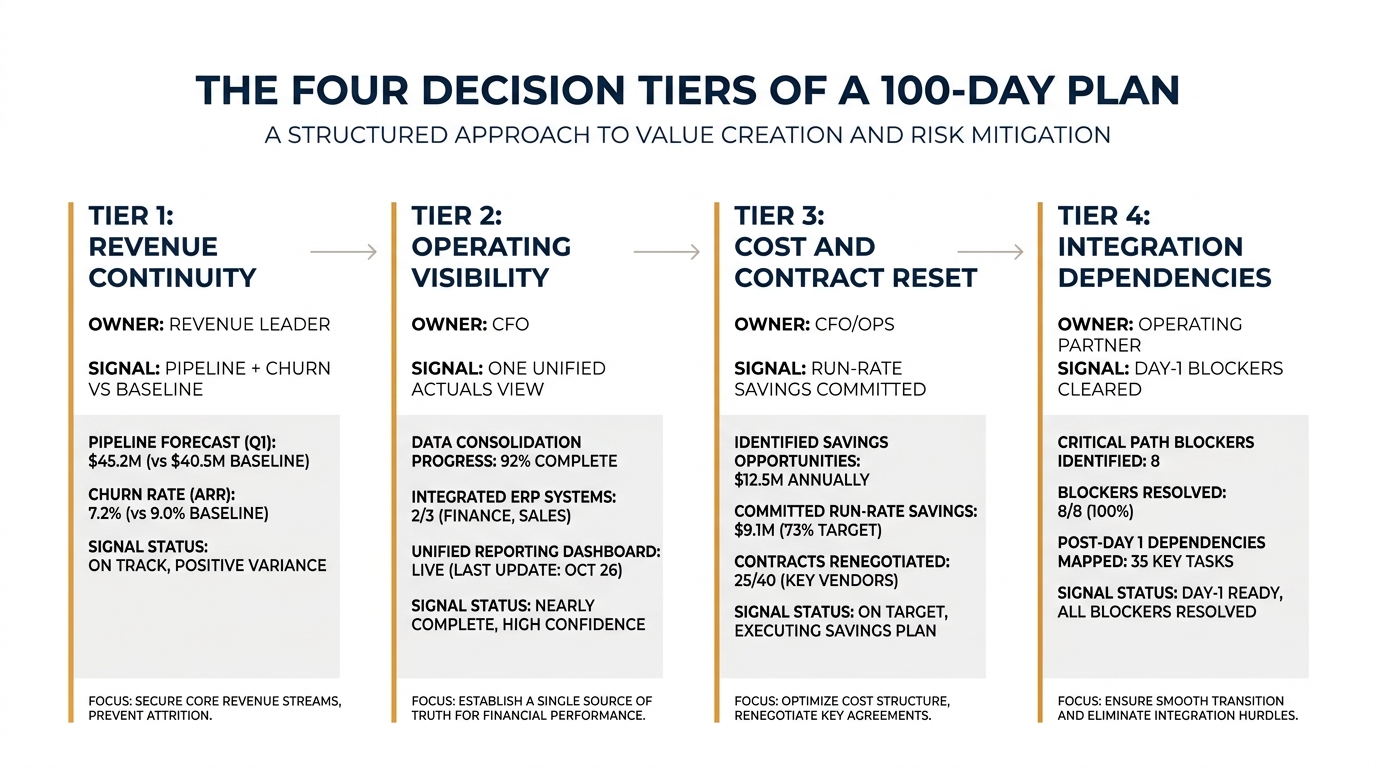
Organize the plan around four tiers of decisions in the order the money depends on them. Each tier has an owner with the decision right, a baseline captured before Day 1 where possible, and a measurable signal that tells the board whether it is on track. The tiers are revenue continuity, operating visibility, cost and contract reset, and the integration dependencies that unlock everything downstream.
This ordering matters because the common failure is to lead with systems consolidation, which is slow and visible, while revenue quietly leaks in the first six weeks. McKinsey’s private capital research has documented how value erodes fastest in the earliest post-close window, before anyone has the reporting to notice. The sequence below is designed to protect the number first and tidy the infrastructure second. See the firm’s work on integration at McKinsey’s private capital research.
Tier one is revenue continuity, and it starts before Day 1
The first decision is how to keep the combined revenue engine running while the back end changes underneath it. That means naming who owns the pipeline across both entities on Day 1, deciding whether the two teams keep separate CRMs for now or merge, and setting a baseline for churn and bookings so you can see leakage as it happens rather than at quarter end.
Much of this cannot wait for close. The decisions that have to land in advance are covered well in this read on pre-close value creation planning. The operational mechanics of keeping two revenue systems from colliding are the subject of post-acquisition RevOps integration, which is where most 100-day plans understaff.
What to decide, not just track
- Which CRM is the system of record, and the date the second one becomes read-only.
- Who owns cross-sell targets in the thesis, and whether the comp plan supports them on Day 1.
- The churn and bookings baseline, captured from actuals in the source systems.
Tier two gives the board numbers it can trust
The second tier is operating visibility, and it is usually where the first board meeting goes wrong. If the CFO is reconciling two chart-of-accounts structures by hand and the revenue data lives in disconnected systems, the board is looking at a forecast nobody can defend. The decision here is what the single source of actuals is, who maintains it, and how fast the first unified view ships.
Practically, this means read-only connections into the ERP, CRM and martech on both sides, a unified model, and a dashboard leadership can read alongside the Excel finance already lives in. Both formats, same data. A technology due diligence process should have surfaced the state of these systems before close; if it did, the 100-day plan inherits a map rather than starting cold. See what that assessment should produce in technology due diligence.
Tier three resets cost and contracts while the window is open
The early post-close period is the only time a buyer has clean leverage to renegotiate vendor contracts, rationalize overlapping tools, and reset a cost base before the two organizations settle into one. Decisions that slip past Day 100 tend to slip past the year. The cost reset deserves its own short list of decisions, laid out clearly in the 100-day cost reset and the four decisions that cannot wait.
The signal the board should see here is committed run-rate savings, classified honestly. A saving you have identified is not the same as one you have signed, and the plan should not let forecast savings read as realized. That distinction is what separates a credible cost tier from a wish list.
Tier four clears the integration dependencies that block the rest
Some decisions unlock several others and have to be made early even when they are uncomfortable. Departing staff are a common one. When a key person leaves inside the first 100 days, the plan needs a named successor or a bridge, not a note that the role is open. Tooling migrations, data ownership and access rights sit here too, because nothing in the upper tiers moves until they are resolved.
Map these dependencies first and own them at the operating-partner level, because they rarely have a natural home in either legacy organization. The sequencing work this requires is close to what a value creation execution partner delivers in the first 100 days.
How to judge the plan before you sign off on it
Read the plan once looking only for four things, and judge it on whether they are present rather than on how polished the deck is.
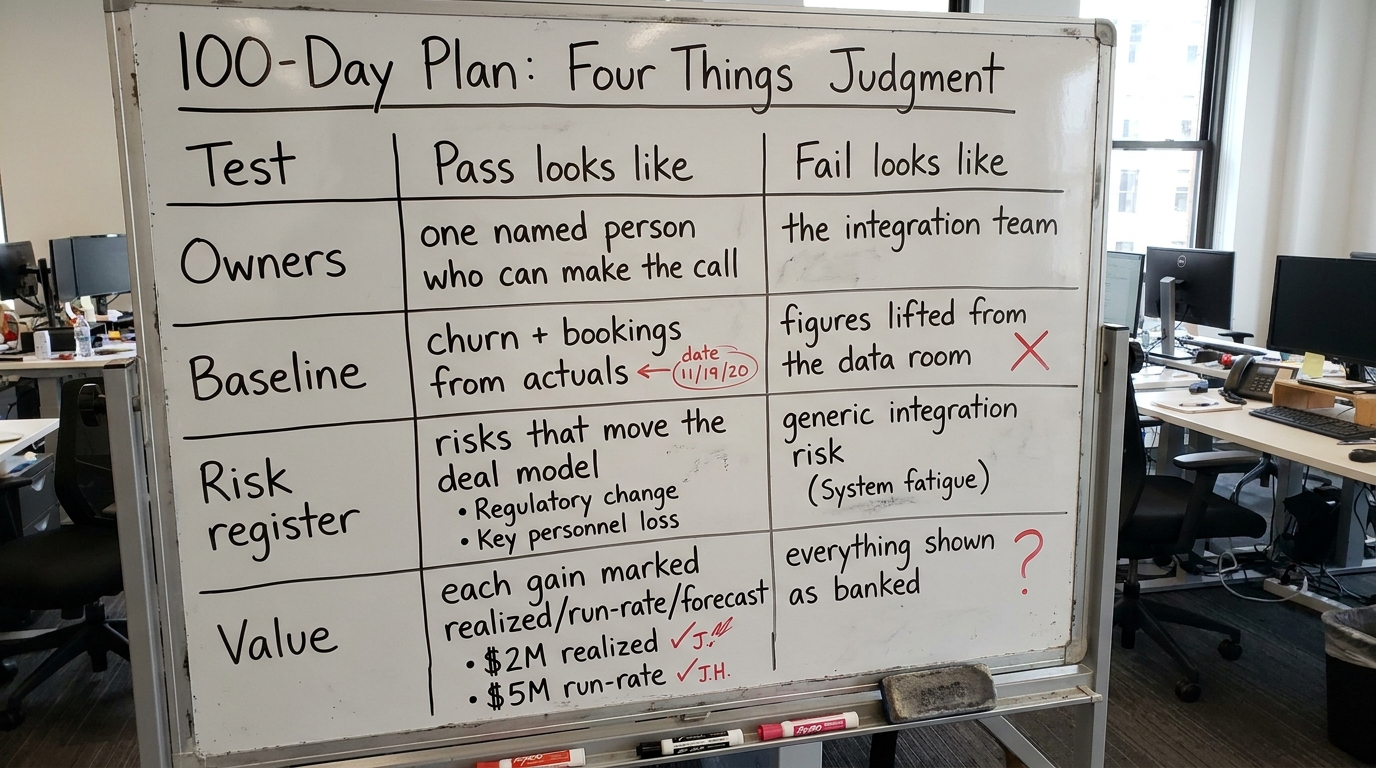
- Owners with decision rights. Every workstream names one person who can make the call.
- Baselines captured from actuals. You cannot report actual against plan if the plan has no baseline, and data-room figures are not a baseline.
- A risk register tied to the thesis. The risks listed should be the ones that move the deal model.
- Classified value. Each claimed improvement is marked realized, run-rate, forecast or risk avoided, so nothing soft reads as banked.
If you are weighing whether to buy this capability or build it, the questions to ask a provider are the same ones in what a value creation partner has to own before you sign and in the companion piece on what a value creation advisor actually owns.
An applied example: a two-entity carve-out at Day 1
Consider an illustrative scenario. A platform acquires an add-on that runs its own CRM, its own billing, and a separate finance team. The deal thesis assumes cross-sell between the two customer bases inside year one and a cost reduction from consolidating duplicate tooling.
A defensible 100-day plan for this case would name the platform’s revenue leader as owner of a single pipeline view by Day 30, keep both CRMs live but make the add-on’s read-only by Day 60, and capture a churn baseline on both books in week one. The CFO owns a unified actuals dashboard by the first board meeting. The cost tier commits signed vendor consolidations, not identified ones, by Day 90. And the operating partner owns the two dependencies that block everything else: who runs the add-on’s finance function after its lead departs, and when customer records move to one system. The due-diligence work behind a carve-out like this is covered in due diligence for infrastructure assets.
What the plan should look like by the first board meeting
By the time the board convenes, the plan should have moved from intention to evidence on the tiers that matter most. The revenue baseline exists and shows whether leakage started. The unified actuals view is live. The cost reset shows committed figures. And the dependency list shows which Day-1 blockers are cleared and which are late, with a reason.
Boards and investors increasingly expect this discipline documented, and the governance expectations around post-close reporting are discussed on the Harvard Law School Forum on Corporate Governance. A plan that arrives at the first board meeting as a status narrative rather than actual-against-plan gets rewritten in public, because the board reads it as unfinished work. The work of making a plan hold up at that meeting is set out in how to build a portfolio value creation strategy that survives the first board meeting.
Next steps and where execution fits
Before the next integration, run the plan on your desk through this checklist.
- Confirm each of the four tiers has one owner with the decision right.
- Check that revenue continuity decisions are dated before or on Day 1.
- Verify the unified actuals view has a ship date earlier than the first board meeting.
- Mark every claimed improvement as realized, run-rate, forecast or risk avoided.
- Pressure-test the cost tier for signed versus identified savings.
The data visibility and RevOps execution underneath tiers one and two is where plans most often stall for lack of hands, and it is the specific work covered under first 100 days execution. If you want a partner to own the digital and revenue-systems side of a post merger integration 100 day plan, see how the DevriX private equity team scopes 100-Day Digital Execution against your integration dependencies and baseline.